
HKSH Uses AI for Speedier Diagnosis and Assessment for Severe Acute Stroke Patients Going Beyond the Golden 3-Hour Treatment Time Window
- HKSH News
- 25 Jan 2021
Hong Kong Sanatorium & Hospital (HKSH) has launched an enhanced programme for severe acute stroke patients in which artificial intelligence (AI) is used to determine the amount and percentage of salvageable brain tissues based on neurovascular magnetic resonance imaging (MRI) and perfusion scanning. This will allow doctors to determine the patient’s eligibility for endovascular therapy (Intra-arterial thrombectomy / IA thrombectomy) and bring hope for more treatment options to patients who might have missed the golden 3-hour window after stroke onset.
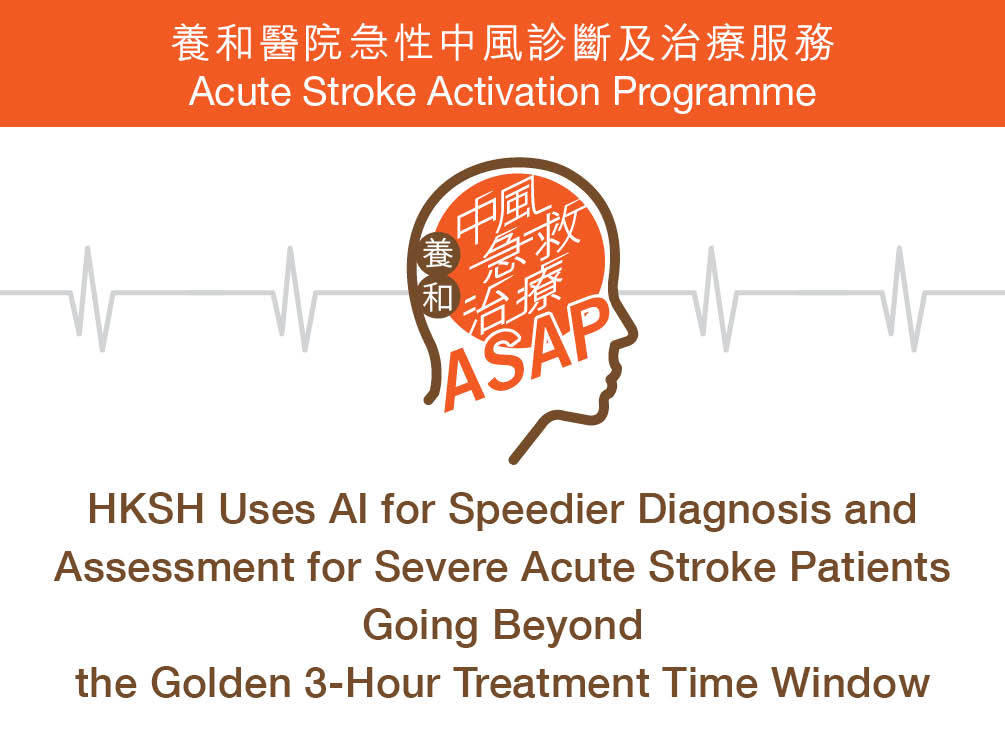
With the launch of Acute Stroke Activation Programme 2.0 (ASAP 2.0) eight months ago, HKSH was the first medical institution in Hong Kong to apply RapidAI software, an AI-enhanced cerebrovascular imaging system, for stroke diagnosis and treatment as well as the first local private hospital to provide 24/7 acute stroke service and IA thrombectomy for ischaemic stroke patients. Two acute stroke patients received IA thrombectomy with the guidance of the AI system and achieved a desirable treatment outcome.
HKSH has all along been strving our patients with state-of-the-art medical technologies. The application of the AI system has made it possible for us to go beyond the limit of the acute stroke golden 3-hour time window by assessing the amount and ratio of salvageable to irreversibly damaged brain tissues. With the launch of ASAP 2.0, severe ischaemic stroke patients who arrive at the hospital beyond 3 hours after onset can undergo perfusion scanning and assessment with RapidAI software. The combination of perfusion scanning and AI system provides objective measurement to guide neurologists and neurosurgeons in determining the patients’ eligibility for IA thrombectomy which is not limited to within 3 hours of stroke onset. That said, the earlier the acute stroke patients get medical treatment, the better the chance of good recovery .
This enhanced 2.0 programme will be built on the existing ASAP 1.0 programme which was launched in 2016 and has so far managed a total of 98 cases. Assessment and treatment are two essential service aspects under ASAP. Upon the arrival of any suspected stroke patient to the 24-hour Outpatient Department (OPD), the Resident Medical Officer (RMO) will provide priority assessment to the patient. If the preliminary diagnosis of acute stroke is established, ASAP 1.0 will be activated and priority CT brain scan will be performed on the patient to differentiate between haemorrhagic or ischaemic stroke, while in-house neurologist will be called back to provide assessment.