



Parkinson’s Disease

What is Parkinson’s Disease?
- Parkinson’s disease (PD) is a progressive neurodegenerative disorder that affects the control of motor activities, leading to limb stiffness and slowness of movements in PD patients.
- Besides medical treatment, recent research has shown that exercise can help PD patients improve physical functions and cope better with activities of daily living.
Parkinson’s Disease: What problems will you face? How can we help you?
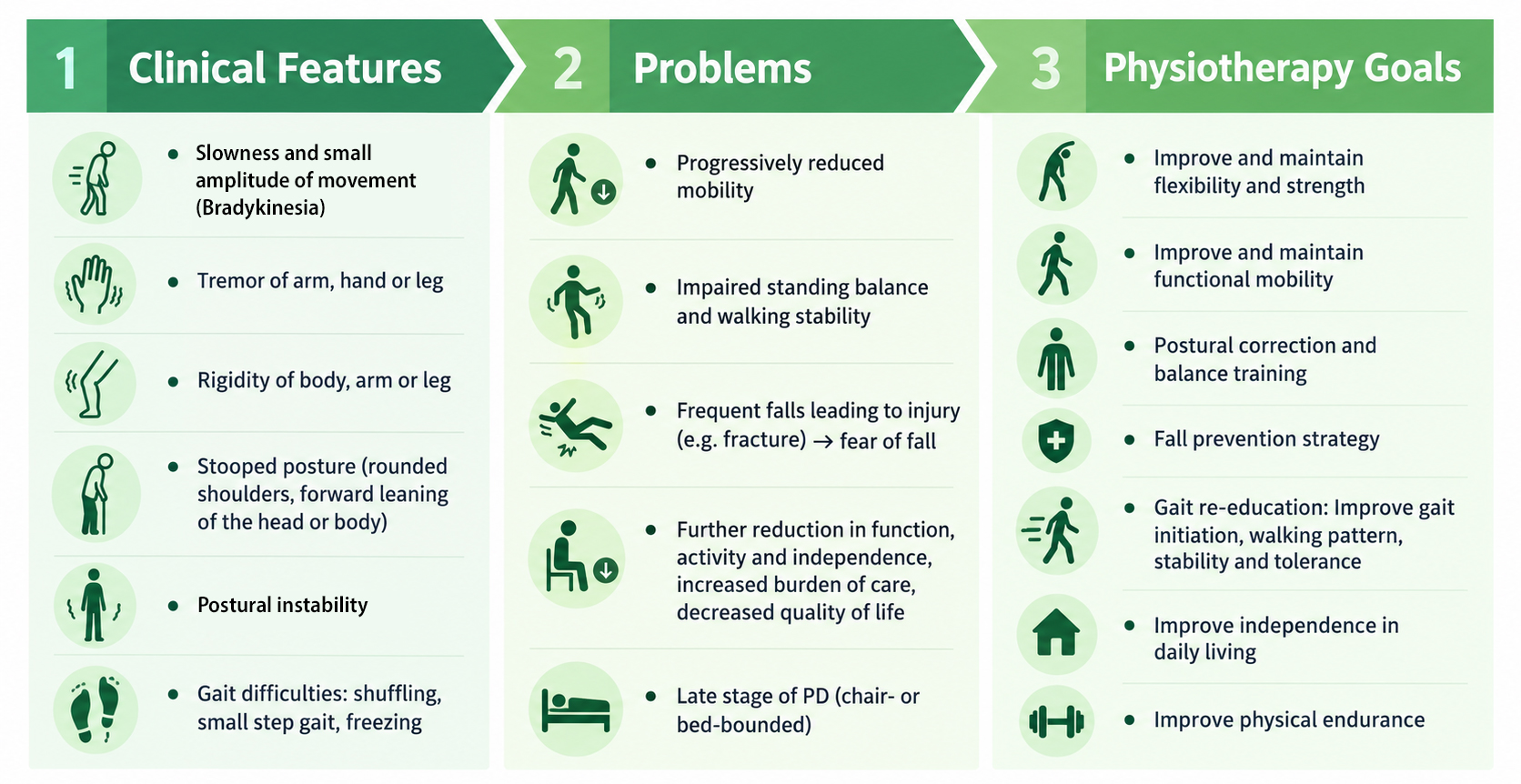
Our Physiotherapy Training for
Parkinson’s Disease Patients

Movement Strategies
- Visual or auditory cues are commonly used to help PD patients improve the initiation and coordination of their walking patterns
- Visual cues include line markers on the floor or the use of laser cane
- Auditory cues include rhythmic sound from metronome

Stretching and Strengthening Exercises
- Stretching exercise maintains flexibility and reduce stiffness
- Strengthening the core and lower limbs provides better postural support and stability
- Using resistance bands, weights or machines can train large muscle groups progressively

Postural and Balance Training
- Focus on improving body alignment and stability (e.g. standing balance and weight shifting)
- Utilise rhythmic and coordinated motions to challenge balance (e.g. boxing)
- Reduce fall risk

Transfer and Gait Training
- Enhance mobility in daily activities (e.g. rising from a chair, getting in and out of bed)
- Maintain a safe walking pattern (with or without walking aids)
- Use coping strategies such as auditory or visual cues to improve coordination of motion and reduce freezing of gait during walking

Cardiovascular Training
- Activities such as cycling or treadmill walking can improve cardiovascular and respiratory functions
- Improve exercise endurance and reduce fatigue