



Overview
Paediatric Eye Diseases
- The first 8 years of life are the critical developmental stage of our visual system
- Children should have a comprehensive eye examination at the age of 4
- Children aged below 4 should seek medical attention as early as possible if an eye problem is suspected
Refractive Error in Children
Newborn infants are able to see. Their vision continues to develop over the first eight years of life, which is a critical period for visual development. If any eye problem occurs during this time, visual development may be hindered. If left untreated, these issues could lead to lazy eye or other irreversible outcomes on vision.
Young children often cannot express their visual problems. Therefore, it is recommended that parents arrange for their children to have their first comprehensive eye examination by the age of four, to diagnose and treat any issues like nearsightedness, farsightedness, astigmatism, squint, lazy eye, congenital cataracts, etc. Early detection allows for prompt treatment. If the eyes are found to be normal, this establishes a baseline for future reference. It is also recommended to have annual eye check-ups to ensure normal visual development.
Nearsightedness (Myopia)
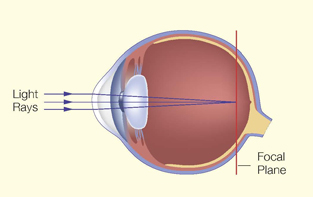
Myopia is very common in Hong Kong, with about 18% of six-year-old students being myopic, and the rate increasing to as high as 62% by the age of twelve. The cause of nearsightedness is an elongated eyeball. The condition continues to worsen with age until the eyeball’s length stabilises after puberty. Symptoms include blurred vision for distant objects, difficulty seeing the board in class, and narrowing eyes to see things clearly. Wearing glasses is recommended to correct vision and prevent lazy eye.
Farsightedness (Hyperopia)
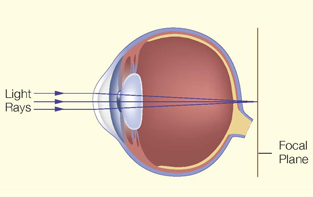
Farsightedness is less common than nearsightedness in Hong Kong children. It occurs because the eyeball is too short. It usually improves as the eye grows, and its symptoms are less obvious than nearsightedness. Mild farsightedness (under 2 dioptres) allows for clear vision due to lens elasticity. Severe farsightedness causes focusing issues, poor vision, and can lead to squint and lazy eye. Under these circumstances, the child must wear glasses.
Astigmatism
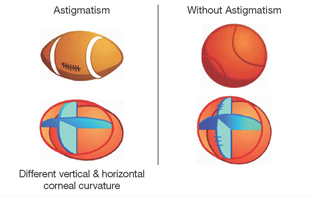
In astigmatism, the curvature of the cornea is different along different axes. As a result, light rays entering the eye are focused at different points instead of a single point. This will create a blurry image. The child may suffer from eyestrain. He/She may narrow his/her eyes or adopt a head posture in order to see more clearly. A child with severe astigmatism requires glasses.
Squint (Strabismus)
Squint is a condition when there is a physical misalignment of both eyes. The eyes do not point in the same direction. One eye focuses while the other deviates inwards, outwards, upwards, or downwards. A child with a squint will primarily uses his/her dominant eye for vision, suppressing the image from the misaligned eye. This affects depth perception and can lead to a lazy eye. A squint can also affect a child’s self-esteem and social life because of how it makes him/her look.
The cause of squint is often an imbalance in eye muscles. In a small number of children, squinting can be a sign of more serious underlying eye conditions, such as congenital cataracts or eye cancer, etc. We should never neglect a squint. If a squint is noticed, an eye examination is necessary.
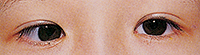
Convergent Squint
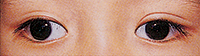
Divergent Squint
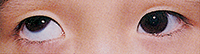
Vertical Squint
Besides, many people confuse “pseudo squint” with “true squint”. In a child with pseudo squint, his/her eyes are actually normal and are well aligned. However, a wide and flat nose bridge gives the illusionary appearance of crossed eyes. As he/she grows older and the nasal bridge becomes higher, it gives a perception that the squint has improved.
In a child with true squint, the eyes are misaligned and the condition will not improve as he/she grows. He/she needs early treatment to realign the eyes and allow normal vision to develop. Treatment of squint includes use of glasses, patching, visual training and surgery.
Lazy Eye (Amblyopia)
During the first eight years of life, the visual system is in a developmental stage. If the visual function of the eye is hindered during this stage, the eye will not develop properly, leading to lazy eye. Lazy eye commonly occurs in only one eye of a child, the cause can be squint, strong degree of refractive error in one eye, droopy eyelid, or eye diseases like cataract. It causes the child to rely on the better eye to see. As the signs are usually inapparent, parents might not be aware that their child has lazy eye unless they bring their child for a formal eye examination. After the age of eight, lazy eye becomes irreversible and is not correctable with the use of glasses. If detected in early childhood, lazy eye can be corrected by patching the normal eye.
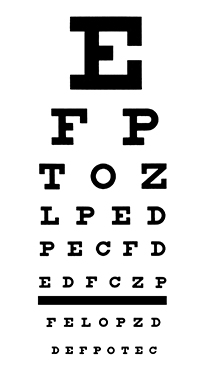
Normal Vision
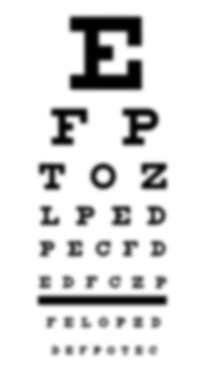
Amblyopic Vision
Symptoms and Diagnosis
Eye Examination
Eye doctors can examine a child of any age and check whether the child has any eye problems. For infants, the eye doctor may need to use special techniques, instruments or diagnostic eye drops / medications.
We recommend that all children have an annual comprehensive eye examination after the age of four. If you notice any of the following conditions, you should take your child to see an eye doctor as soon as possible, regardless of age.
- Abnormal visual responses, such as not responding to light, not following toys, or not recognising their parents' faces
- Abnormal eye appearance, e.g. droopy eyelids, redness, swelling, bulging eyes, or a white reflection from pupils
- Frequent blinking, eye rubbing, or excessive tearing
- Blurred vision or double vision
- Abnormal alignment of eyes, with one of the eyes turning inwards, outwards, or upwards
- Head tilt when looking at objects
- Narrowing of eyes when looking at objects or copying from the board in class
- Any other conditions that cause concern
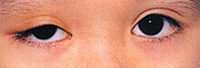
Droopy Eyelid

Congenital Cataract
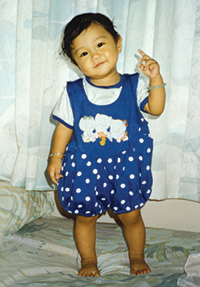
Head Tilt Caused by Vertical Squint
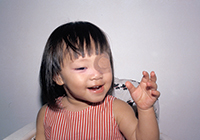
Treatment of Lazy Eye with Occlusion
Contact Us

Happy Valley
- Address:
- 4/F, Li Shu Fan Block,
Hong Kong Sanatorium & Hospital,
2 Village Road, Happy Valley, Hong Kong
- Service hours:
-
Monday to Friday: 9:00 am - 5:00 pm
Saturday: 9:00 am - 1:00 pm
Closed on Sundays and Public Holidays
Consultation by Appointment
- Tel.:
- (852) 2835 8880
- Email:
- [javascript protected email address]
- Fax:
- (852) 2892 7510
- WhatsApp:
-
(852) 2835 8890
(For non-emergency cases)

Admiralty
- Address:
- 21/F, One Pacific Place,
88 Queensway, Hong Kong
- Service hours:
-
Monday to Friday: 9:00 am - 5:00 pm
Saturday: 9:00 am - 1:00 pm
Closed on Sundays and Public Holidays
Consultation by Appointment
- Tel.:
- (852) 2855 6700
- Email:
- [javascript protected email address]
- Fax:
- (852) 2523 7660
- WhatsApp:
-
(852) 2855 6700
(For non-emergency cases)

Admiralty
- Address:
- 21/F, One Pacific Place,
88 Queensway, Hong Kong
- Service hours:
-
Monday to Friday: 9:00 am - 5:00 pm
Saturday: 9:00 am - 1:00 pm
Closed on Sundays and Public Holidays
Consultation by Appointment
- Tel.:
- (852) 2855 6699
- Email:
- [javascript protected email address]
- Fax:
- (852) 2523 7660
- WhatsApp:
-
(852) 2855 6699
(For non-emergency cases)

Happy Valley
- Address:
- 6/F, Central Block,
Hong Kong Sanatorium & Hospital,
2 Village Road, Happy Valley, Hong Kong
- Service hours:
-
Consultation by Appointment
- Tel.:
- (852) 2835 8890
- Email:
- [javascript protected email address]
- Fax:
- (852) 2892 7538

Admiralty
- Address:
- 22/F, One Pacific Place,
88 Queensway Hong Kong
- Service hours:
-
Consultation by Appointment
- Tel.:
- (852) 2855 6700
- Email:
- [javascript protected email address]
- Fax:
- (852) 2892 7429