
Speech Therapy
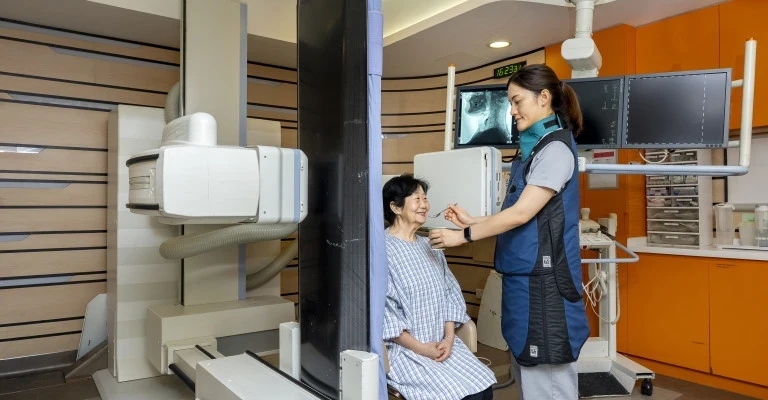
At HKSH, our speech therapists support your communication and swallowing needs
Communication and swallowing are central to daily life, health, and relationships. Having a communication or swallowing problem at any life stage can be challenging for you or your significant others.
Our speech therapists provide comprehensive evaluation, diagnosis, and therapy tailored to your specific communication or swallowing problem. Whether challenges arise from developmental disorders, surgery, or other medical conditions, we deliver personalised care to help you restore your functional abilities and rebuild your confidence.
These specialist services are available to people of all ages on both an inpatient and outpatient basis. Therapy is primarily delivered through one-on-one sessions, ensuring you receive dedicated attention and the highest standard of customised care.
Services
Our speech therapists can evaluate and manage communication (speech, language, voice, fluency) and swallowing and feeding disorders, which may result from various conditions.

Communication Disorders
Communication disorders can occur as a result of various medical conditions and treatments due to aging or developmental disorders.
Neurogenic communication disorders result from damage to the brain, which may be caused by diseases such as stroke, Parkinson’s disease, brain tumour or head injury. A person experiencing a communication disorder may have problems with speaking, understanding what is being said, reading and/or writing. They may be unable to express their needs or thoughts, produce brief speech, slurred speech or speech that is difficult to understand.
Treatment
Treatment varies according to individual needs and the type of disorder present. It may involve improving the strength and coordination of the speech muscles, re-learning how to produce sounds, words or sentences correctly or, in more severe cases, using appropriate gestures or communication devices to aid communication.
People with head and neck cancers may have undergone surgery, radiotherapy or other treatments. Owing to changes to the head and neck structures or the late effects of radiotherapy (e.g. tissue hardening), problems with speech, voice or swallowing may arise.
Treatment
Pre-operative counselling is essential to prepare you for the potential changes that may occur following treatment of speech functions and the likely rehabilitation that will be needed after surgery and/or other treatments.
After surgery to remove the voice box (larynx), we offer timely speech rehabilitation using special devices such as an electrolarynx or tracheo-oesophageal speech prosthesis. Speech exercises may also be introduced to optimise speech intelligibility.
Tracheostomy tubes may be placed by a medical doctor for people who need assistance with breathing. A patient with a tracheostomy tube may find it difficult to speak even speak at all. They may also have difficulties with swallowing.
Treatment
Our speech therapist can assess whether a speaking valve or other speech devices can be used for communication. Exercises to improve the coordination of breathing for speech may also be taught.
Voice problems may arise from misuse of the voice or from an underlying medical problem. People who use their voice frequently are more prone to voice disorders.
Common signs and symptoms of voice disorders may include having a hoarse or breathy voice, vocal fatigue, difficulties raising your voice or controlling the pitch of your voice.
Treatment
Voice therapy may consist of a variety of tasks designed to eliminate harmful vocal behaviours, shape healthy vocal behaviour, and assist vocal fold wound healing after surgery or injury. Treatment may include voice therapy alone, or voice therapy in conjunction with ENT management. Therefore, you are advised to consult an ENT specialist for a detailed examination of the vocal cords and management plan.
When children have difficulty speaking clearly, pronouncing particular sounds or words, following directions or putting words together into sentences, they may have a speech and/or language delay or disorder. These speech and language disorders may be due to a variety of factors, rather than a single cause. Conditions that affect speech and language development could include structural abnormalities such as cleft lip/palate and tongue tie, developmental delays, intellectual impairment, autism spectrum disorders, hearing loss or limited language exposure.
These can lead to difficulties with understanding, using or socially applying language. Early identification and targeted intervention are crucial for helping children develop effective communication skills.
Treatment
Our speech therapist will administer appropriate assessments to determine the need for therapy, depending on the age and nature of the disorder identified.
Fluency disorders affect the speed, rhythm and flow of speech. Fluency disorders can be developmental, beginning in childhood, or can occur later in life due to a brain injury. These disorders, especially those beginning in childhood, may adversely affect an individual’s self-esteem and educational, vocational or social participation. A person with a fluency disorder may speak with part or whole word repetitions, e.g. “h-h-how are you?”, or “how how how are you?”, or sound prolongation, e.g. “sss…sit down please”.
Treatment
Various approaches may be used, such as controlling the rate of speech, easy onset, relaxation techniques and regulation of breathing.

Swallowing and Feeding Disorders
Adults with difficulties swallowing are at risk of poor nutrition, dehydration, pneumonia or suffocation. Swallowing disorders may result from a number of medical conditions:
- Neurological disorders: Such as stroke, Parkinson’s disease and dementia
- Cancers of the head, neck and oesophagus: People who have been treated for these cancers (e.g. oral cancer, laryngeal cancer, nasopharyngeal cancer, oesophageal cancer) may experience swallowing problems. The degree of the problem depends on the size and location of the tumour and the type and nature of the treatment used.
- Respiratory problems: Having a tracheostomy or needing a ventilator may affect one’s ability to swallow safely.
Common signs and symptoms of swallowing disorders:
- Coughing or choking when eating or drinking
- Wet or gurgly voice when eating or drinking
- Having the need to swallow many times to clear food from the mouth or throat
- Eating or drinking with effort
- Long meal times
- Food or liquid leaking from the mouth
- Recurrent pneumonia or fever
- Weight loss or dehydration
Treatment
After a swallowing evaluation, our speech therapist will recommend specific swallowing treatments. These may be in the form of exercises, recommendations on optimal feeding positioning, swallowing strategies or modifying liquid and food textures to allow for safer swallowing. The recommended treatment is based on the cause and presenting symptoms of the swallowing problem.
Feeding and swallowing problems can also occur in infants and young children. Causes may be congenital (e.g. malformations present at birth such as cleft lips and palate) or due to prematurity or neurological damage. Feeding and swallowing problems could also occur when the oral muscles are weak or there is abnormal sensation (oral hyper- or hyposensitivity).
Children with feeding and swallowing problems are at risk of poor nutrition, dehydration and aspiration (food or liquid entering the airway).
Common signs and symptoms of feeding and swallowing disorder:
- Poor sucking
- Refusing to feed
- Difficulty with chewing
- Excessive drooling or food/liquid coming out from mouth or nose
- Coughing during meals
- Difficulty coordinating breathing with feeding
Treatment
Treatments recommended by our speech therapists generally aim to increase the strength of the oral muscles, improve chewing, coordinate the suck-swallow-breath pattern or normalise oral sensitivity. Our speech therapist may also introduce safe textures and advise on postural changes or special feeding bottles and aids. Treatment is based on the cause and presenting symptoms of the swallowing problem.
Orofacial myofunctional disorders (OMDs) affect the growth, development and functions of orofacial musculature. OMDs can co-occur with speech or swallowing disorders.
Common signs and symptoms of OMDs:
- Tongue protrusion between the teeth at rest, during speech or during swallow
- Mouth breathing
- Tongue tie
- Dental abnormalities
- Speech problem
- Drooling over age of 2 years
- Persistent sucking habits, e.g. thumb sucking, prolonged use of pacifier, tongue sucking, etc.
Treatment
Individuals with OMDs may benefit from orofacial myofunctional therapy. Depending on individual needs, other oromotor, speech or feeding therapy may be incorporated. Our speech therapists trained in orofacial myology will collaborate with other medical professionals to provide holistic management of OMDs.
VFSS is an objective assessment used to assess swallowing function. VFSS is conducted under X-ray and is typically done in conjunction with a radiologist. During VFSS, the individual with the swallowing problem is given food and liquid mixed or coated with barium, so that it can be seen under X-ray. During the procedure, the swallowing process is observed to identify the cause of the problem, determine the presence or absence of aspiration, and assess whether compensatory techniques could improve swallowing. Based on the VFSS findings, our speech therapist may discuss treatment and recommendations that aid safe swallowing.
FEES is an objective tool used to assess swallowing. The assessment uses endoscopy and is typically conducted with a specialist doctor. A flexible endoscope is inserted through the nose while food and liquids are swallowed. This allows the swallowing process to be visualised. Food and liquid given during the procedure may be of varying textures, and food colouring may be added to improve visibility. The goals of the procedure are to find the cause of the swallowing problem, assess the presence or absence of aspiration, and identify possible compensatory techniques.

Patient Resources

- Article
- 29 Sep 2023

- Article
- 17 Apr 2023

- Article
- 12 Nov 2021

- Article
- 27 Jul 2021
Contact Us


Happy Valley
- Address:
- 5/F, Li Shu Pui Block,
Hong Kong Sanatorium & Hospital,
2 Village Road, Happy Valley, Hong Kong
- Service hours:
-
Monday to Friday: 9:00 am - 5:00 pm
Saturday: 9:00 am - 1:00 pm
Closed on Sundays and Public Holidays
Consultation by Appointment
- Tel.:
- (852) 2835 7156
- Email:
- [javascript protected email address]
- Fax:
- (852) 2892 7568