



Spine Problems
Everyone will experience neck or lower back pain at least once in their lifetime. Common spinal conditions include prolapsed intervertebral discs, spinal stenosis, spinal cord compression caused by osteophytes or calcified ligaments. Secondary bone tumours affecting the spine are serious conditions that require early intervention.
We specialise in performing spinal surgery using minimally invasive techniques to remove prolapsed disc material. Simple implants may be used to improve spinal stability after surgery and support early rehabilitation. We also work closely with the Department of Physiotherapy to provide spinal pain management programmes.

Sciatica and prolapsed intervertebral disc
What is sciatica?
The sciatic nerve is formed by nerve roots from the lumbar spine. It travels from the lower back, through the buttocks and down the back of the thigh to the leg and foot. Sciatica refers to back pain that radiates along this nerve pathway.
What causes sciatica?
Sciatica is usually caused by pressure or irritation of the sciatic nerve or its roots in the lumbar spine. The most common cause is a prolapsed (herniated) intervertebral disc, typically at the fourth or fifth lumbar level. The protruding disc material compresses the nerve root, leading to symptoms.
What causes a prolapsed intervertebral disc?
Main contributing factors include:
- Frequent lifting of heavy objects or excessive strain on the back
- Poor posture
- Genetic predisposition to weak lumbar spine structures
Symptoms of sciatica
Symptoms vary depending on the severity of the disc prolapse and the pressure on the nerve root. Sciatic pain often worsens with coughing, sneezing or prolonged walking. Patients may also experience numbness in the foot or outer side of the leg. In severe cases, there may be weakness in toe or ankle movement. If numbness occurs in the perineal region along with loss of bladder or bowel control, urgent medical attention is required.
Treatment of sciatica
- Rest – often the most effective initial approach
- Analgesics – to relieve pain
- Physiotherapy – including hot or cold packs, ultrasound, lumbar traction and other modalities
Exercises
Exercise recommendations depend on the severity of the condition. Patients should monitor changes in pain intensity or location during exercise. Fluctuations in pain are common during treatment. If pain worsens, medical advice should be sought immediately.
The following exercises may help relieve symptoms:
Exercise 1
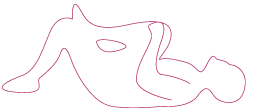
- Lie flat on the back. Bend the knees
- Hold the left knee with both arms.
- Hold it for 5 seconds and release. Repeat 5 times
- Repeat the same with the other leg
Exercise 2
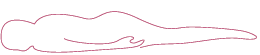
- Lie on chest (a first-aid exercise for acute pain)
- Use hot packs to relax the back muscle
- 5 minutes every 2 hours
Exercise 3
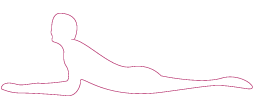
- Lie on chest. Place the elbows under the shoulders and support the body with the forearms
- Relax the back
- Hold it for 2 to 3 minutes
Exercise 4

- Lie down with face down. Place hands under the shoulders in the press-up position
- Straighten the elbows slowly. Push the body up and keep the pelvis and legs relax in bed. Relax the back
- Hold it for 1 to 2 seconds and return to starting position
- Repeat 5 times every 2 hours
Exercise 5
- Do this exercise when the back pain and leg pain have subsided
- Stand upright with feet apart by the shoulder width (see diagram)
- Place the hands to support the lower back
- Slowly bend backward and keep knees straight
- Avoid bending too much and causing pain to the back and the leg
- Hold it for 1 to 2 seconds and return to starting position
- Repeat 5 times every 2 hours
Surgical treatment: Microdisectomy
When symptoms are serious, surgery may be required. Microdisectomy is a minimal access surgical technique used to treat sciatica. Through a 2 cm skin incision and a specially designed instrument, the prolapsed intervertebral disc materials are removed. Patients can often go back home within a few days.
Possible complications of Microdisectomy
The rate of serious complications following microdisectomy is low. Common ones are:
- General complications in relation to the patient’s general health status such as stroke, heart attack, etc.
- Damage to the spinal nerve with possible permanent loss of sensation and leg movement, and poor urine and bowel control
- Wound infection
- Recurrence of the prolapsed intervertebral disc


Happy Valley
- Address:
- 2/F, Li Shu Fan Block,
Hong Kong Sanatorium & Hospital,
2 Village Road, Happy Valley, Hong Kong
- Service hours:
-
Monday to Friday: 10:00 am - 6:00 pm
Saturday: 11:00 am - 3:00 pm
Closed on Sundays and Public Holidays
Consultation by Appointment
- Tel.:
- (852) 2835 7890
- Email:
- [javascript protected email address]
- Fax:
- (852) 2892 7517
- WhatsApp:
-
(852) 2835 7890
(For non-emergency cases)